
Skip to content

Cookie settings

Choose which purposes you consent to. Nothing is on beforehand, and nothing is fetched until you save. You can change or withdraw your consent at any time via “Cookie settings” at the foot of the page.

Cookie settings

Make the site work and remember the choice you make here. They cannot be switched off, and they do not require your consent.

Show services (1)
  • HLM Landmåling · Provider: HLM Landmåling A/S
    Remembers your cookie choice so you are not asked again on every page.
    hlm_consent (12 months)

Show content we pull in from others - maps, video and 360° views. Without them you get a placeholder you can click if you want to see the content anyway.

Show services (2)

Measure which pages get read, so we can make them better. Not used to recognise you as a person.

Let advertising tools measure what happens after a click on an ad, and follow you across websites.

Show services (1)
  • KOMO Evolution360 · Provider: KOMO A/S
    Measures which ads and sources lead to enquiries: where you came from, and whether you call, write or send the contact form. The content of the form is also sent to KOMO.
    _evo_visit (Persistent (localStorage)), _evo_ref (Persistent (localStorage)), _evo_gclid (Persistent (localStorage)), _evo_keyword (Persistent (localStorage)), _pk_id.* (13 months), _pk_ses.* (30 minutes), _pk_ref.* (6 months)
    KOMO A/S (opens in a new window)
HLM surveyor in an orange hi-vis jacket in front of one of HLM's electric cars on an urban building site

Environment

Precision is environmental work.

The heaviest footprint from a surveying job is not our own - it is everything the site can avoid digging up, hauling away and rebuilding. Here is where our services move most.

Environment The foundation decides the rest

Environment begins in the foundation

A build consumes materials, machine hours and lorry kilometres. How many is largely decided by how well the ground is known before anyone digs.

This is where surveying makes a difference you can feel: an error caught on the drawing costs a revision, and the same error caught after casting costs demolition, new material and haulage both ways. We do not sell an environmental service - we deliver the data foundation the build is designed from, and that foundation is itself one of the biggest levers on what a site consumes.

We are currently accounting for our own footprint, and a proper climate account is the next step. Until it is in place we will not put numbers on this page that we cannot stand behind. What follows are the mechanisms: what our work concretely changes on a site.

5 mechanisms What measurement moves

Where measurement moves most

01

What is set out right does not get rebuilt

A control network that holds is quality assurance for the entire build. Fewer errors mean fewer materials scrapped and hauled away, and fewer machine hours spent putting things right. Setting out and surveying in the field is the cheapest place to avoid waste that otherwise only surfaces once the concrete is poured.
02

Scan first, dig afterwards

Georadar records buried services without digging. That reduces the number of times ground has to be opened purely to find out what is down there - and with it the soil hauled away and the asphalt laid back. Utility mapping with georadar saves the excavation itself, not just the time.

03

Move only the soil that has to move

Precise volume calculations tell you how much soil actually has to be moved, and how much can stay put or be reused on site. Soil haulage is heavy lorry kilometres, so a truthful quantity basis in CAD, data and documentation is one of the calculations that moves most out in the field.

04

One flight instead of a day in the van

Large areas can be surveyed from the air in substantially less time than it takes to walk them - and with fewer kilometres driven both to and around the site. Surveying by drone also yields a fully covering data set, so there are fewer return trips for whatever was missed.

05

Step in before it becomes a construction project

Continuous monitoring of movement and settlement means a deviation is caught while it is still small. The earlier it is found, the less has to be torn down and built up again. Monitoring and surveillance is therefore as much a way to avoid a large intervention as a way to document a small one.

Our own footprint Honestly

Our biggest source is driving to and from the site.

Surveying happens where the building happens, and the vehicle is still the largest part of our own consumption. We choose electric where the job and the range allow it, and we plan to group jobs rather than drive out twice.

It is also why a drone survey or a mobile scan counts twice: it saves kilometres for us and excavations for you. If you want to know what that means for a specific job, get hold of the office nearest to you.

Find your nearest office
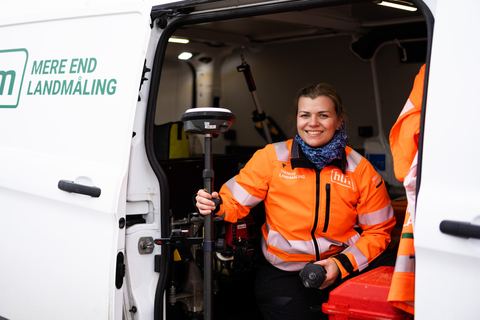
HLM surveyor with a GNSS rover at the open side door of one of HLM's vans
Measured on site, once
Frequently asked questions Without green promises

What can you actually promise?

How does surveying affect the environmental impact of a build?

The foundation decides how much has to be dug, hauled and rebuilt. Accurate control points, georadar utility mapping, truthful soil volumes and aerial survey all reduce the number of excavations, the amount of soil hauled away, and the machine hours spent correcting mistakes afterwards.

Can you document how much CO2 we save?

Not as a figure on your job. We state the mechanism - fewer excavations, fewer kilometres driven, less soil to move - and you fold the saving into your own climate account using your own emission factors. A number from us without a shared basis of calculation would not be usable.

When in a project does the environmental gain pay off best?

Early. A control network and a truthful quantity basis cost least when laid before the first spade goes in, and the errors they prevent are dearest to correct after casting. The later a deviation is found, the more material and machine time it takes to put right.

Contact

How can we help?

Got a question or a task in mind? Call or write - we'll get back to you within one working day.

+45 32 12 51 15 or fill out the form

Ask us

Brief & no obligation - you'll hear from us soon.